
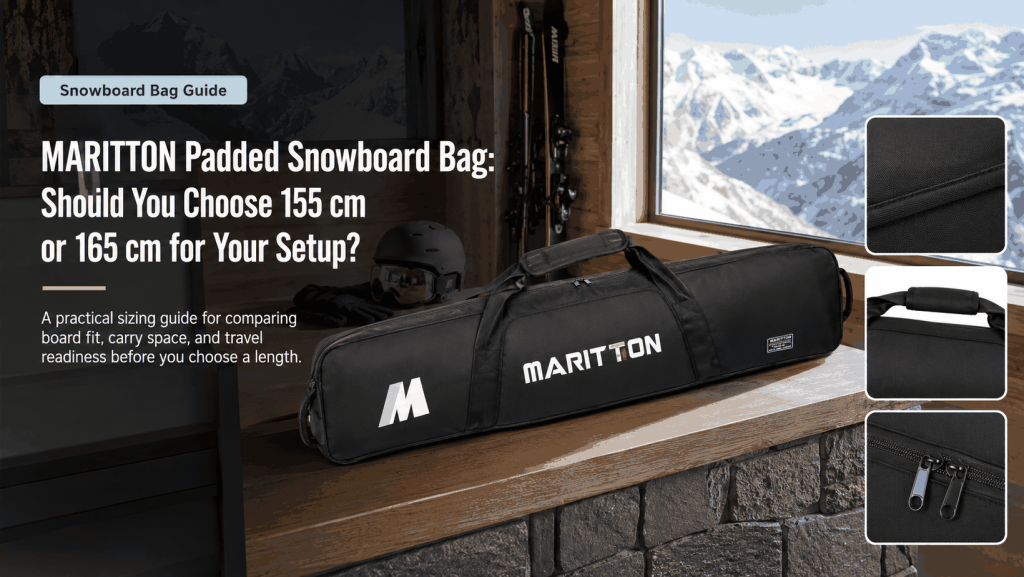
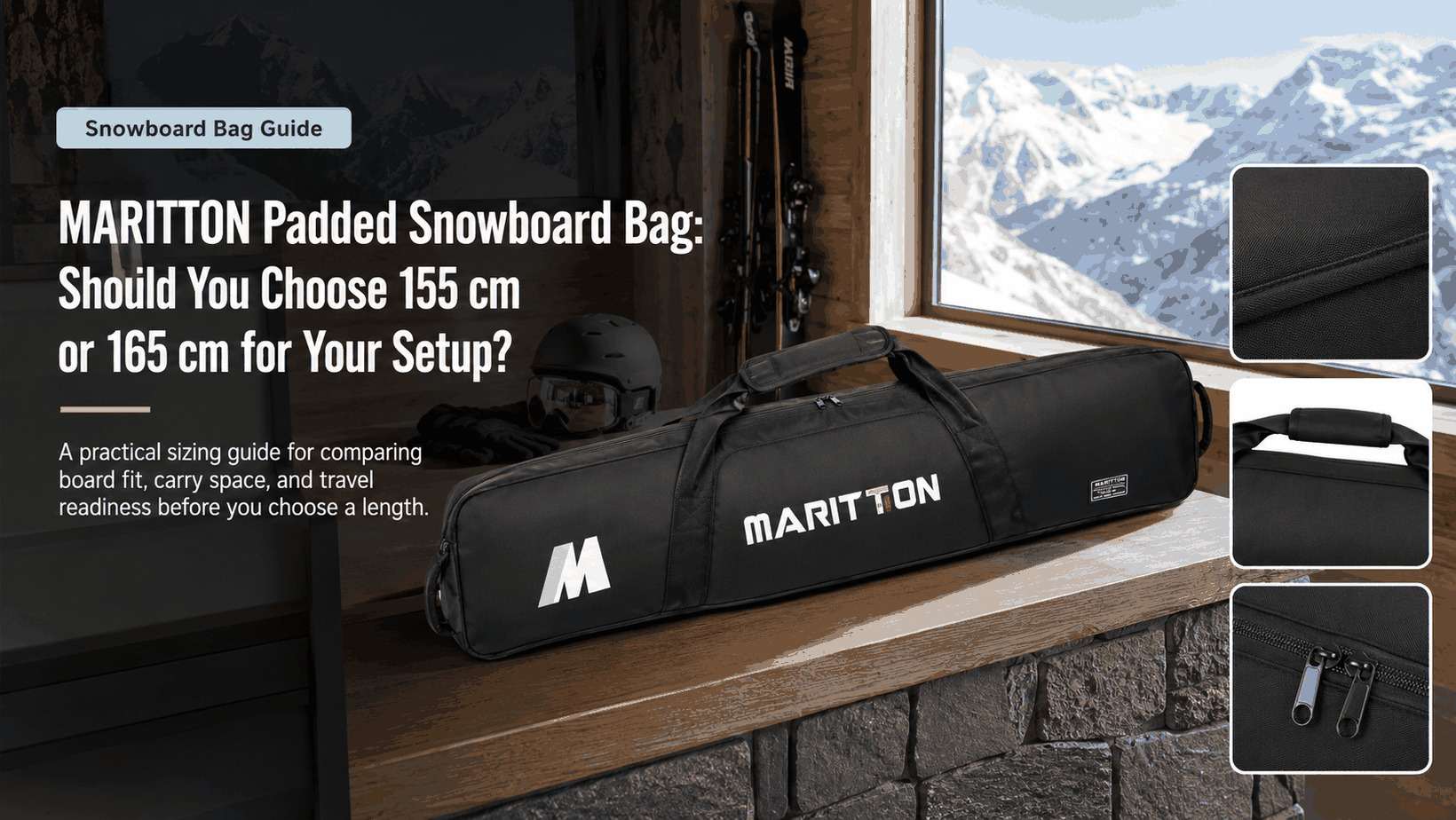
The MARITTON Padded Snowboard Bag is offered around 155 cm and 165 cm length choices, so the decision should start with the board rather than the bag. Measure the snowboard tip to tail, then account for the way bindings sit inside the padded case and whether you plan to add goggles, gloves, or boots.
Choosing the longer version “just in case” can create unnecessary movement for a short board, while choosing too close to the board length can put the nose, tail, or bindings against the zipper and end panels. The useful size is the one that closes naturally with a modest amount of controlled space.
MARITTON Padded Snowboard Bag 155 cm Vs 165 cm Fit Checks
Use 155 cm Only With Verified Clearance
A 155 cm bag should not be treated as a perfect match for every board near that number. End padding and the shape of the board can reduce the usable space, so close the bag with the bindings installed before accepting the fit. Use the MARITTON 155 cm snowboard bag check as the related reference for this specific decision.
Use 165 cm To Add Functional Room, Not Empty Space
The larger option can provide helpful clearance for longer boards or extra gear, but excessive empty length lets the board move. Use internal straps or soft packing only where it stabilizes the load. Use the MARITTON 165 cm snowboard bag check as the related reference for this specific decision.
Measure The Board In Its Travel Configuration
Record the actual board length and note any unusually wide nose or tail. A quick measurement before shopping prevents a bag-size decision based only on the board’s model name. Use the snowboard length fit test check as the related reference for this specific decision.
Treat Binding Height As A Separate Dimension
Bindings can create the highest point of the packed board and may press against the top panel. Check whether the bag closes flat and whether binding hardware can rub the zipper. Use the bindings clearance in padded bag check as the related reference for this specific decision.
Add Accessories Only After The Board Fits
Goggles, gloves, and clothing can fill small spaces safely when protected, but they should not turn into hard lumps around the bindings. Boots add much more bulk and need a deliberate packing plan. Use the snowboard accessory packing space check as the related reference for this specific decision.
Check The Airline Rule After Choosing Bag Length
A good board fit does not automatically mean a good baggage fit. Measure the packed exterior and compare it with the current policy of the operating airline before departure. Use the airplane snowboard bag sizing check as the related reference for this specific decision.
155 cm Or 165 cm Decision
Use this table after the first dry-pack. The goal is to turn a product claim into a repeatable check you can perform with the exact equipment that will travel.
| Check | What to Do | Why It Matters |
|---|---|---|
| Board under the shorter size with clear margin | Test 155 cm first | Avoid unnecessary empty length |
| Board near 155 cm limit | Test binding and end clearance | 165 cm may be more practical |
| Board approaching 165 cm | Use measured packed profile | Do not force the shorter case |
| Boots included | Check width and height carefully | May require combo or larger format |
| Frequent flights | Prioritize closure and padding space | Avoid zipper tension |
Pre-Flight Packing Checklist
- Measure the board from tip to tail
- Leave bindings in the intended travel position
- Check nose and tail padding thickness
- Close the bag without pressing down on it
- Lift the bag and test for sliding
- Add goggles only in protected space
- Measure the packed exterior
- Record the size that works for future trips
Run the checklist with the bag completely loaded. An empty-bag inspection cannot reveal balance, zipper tension, internal movement, or the way hard gear presses into the shell.
Airline Rule Check
Sports-equipment policies can change by airline, route, aircraft, fare type, and baggage weight. Measure and weigh the finished bag at home, then compare the result with the operating carrier’s current rules before travel.
For a current official reference, review TSA’s current “What Can I Bring?” guidance. Use the airline page for the final decision rather than relying on an old forum post or a previous trip.
Final Buying Decision
The 155 cm versus 165 cm choice is not a style preference; it is a clearance decision. The board should sit securely with enough room for padding and bindings while remaining controlled when the bag is carried.
Measure first, test the travel configuration, and then check airline rules. That approach prevents both the too-tight bag and the oversized sleeve that allows the board to move.
Frequently Asked Questions
Should a 155 cm snowboard use a 155 cm bag?
Not automatically. End padding, board shape, and bindings can require additional usable length.
Is 165 cm too large for a much shorter board?
It can be if the bag has no effective way to control movement. Test how much the board slides after the bag is closed.
Do bindings need to be removed for travel?
Not always. Compare fit with bindings installed and remove them only when appropriate for the board, bag, and travel plan.
Can boots go in the same snowboard bag?
Some bags allow it, but boots add substantial width and weight. Confirm the bag’s intended capacity and airline rules.
How much padding clearance should I leave?
Leave enough space that the zipper and end panels are not under hard pressure, while keeping the board from moving freely inside the case.
