
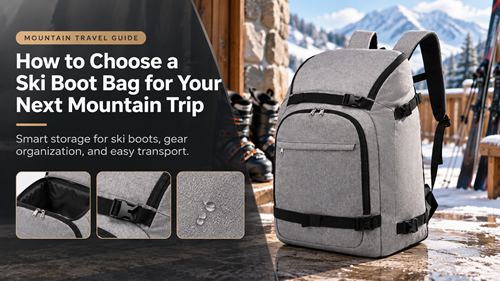
A ski boot bag becomes useful when it does more than hold two boots. The right layout keeps wet soles away from goggles and clothing, gives a helmet enough uncompressed space, and stays balanced when carried through airports, parking lots, hotel lobbies, and resort shuttles.
Before buying, pack the boots, helmet, gloves, goggles, base layers, and small accessories you normally bring to the mountain. Boot size alone does not predict fit because shell shape, buckle position, helmet profile, and compartment geometry use space differently.
How to Choose a Ski Boot Bag That Fits Your Gear
Choose the carry format before comparing liters
A backpack, duffel, or rolling ski boot carrier changes how the load feels. Backpack straps free both hands; a duffel is simple to open; wheels reduce terminal carrying but add weight and hardware.
Test the format with both boots loaded. The bag should remain upright enough to set down safely and should not pull sharply backward when worn.
Give wet boots a defined storage zone
A boot storage bag needs a drying plan as much as a travel plan. Ventilation panels, drain-friendly lining, and separate boot compartments help, but wet shells still need to be removed and dried after use.
Do not seal damp liners, gloves, and clothing together overnight. Empty the bag after skiing and let each compartment dry before the next day.
Protect small ski accessories from hard shells
Use dedicated pockets or small pouches for ski accessories such as goggles, lenses, straps, tools, and chargers. Boot buckles can scratch or crush fragile items when everything is loose in one cavity.
Keep goggles in a rigid or padded case when possible. Place gloves and base layers around stable items rather than using them to jam an overfilled zipper shut.
Think about the whole winter transfer
Your winter travel gear moves through more than the ski hill. Airport security, rental cars, stairs, elevators, lockers, and shuttle racks all reward a bag that is compact and easy to grip.
Load the bag, put on your normal travel jacket, and walk a realistic distance. Check whether shoulder straps rub the collar, whether the bag clears doorways, and whether the weight stays centered.
Use padding where boots and helmet can collide
A padded boot bag should protect contact points without creating unusable bulk. Inspect the base, sidewalls, helmet zone, and any divider between boot shells.
Padding is most valuable when it prevents hard parts from striking one another. Thick foam in an empty corner is less useful than controlled separation around buckles and lenses.
Pack the mountain essentials in a repeatable order
Treat the bag as part of your ski trip essentials system. Boots go in first, then helmet, then protected goggles, then soft layers and small items in dedicated pockets.
A repeatable sequence makes it easier to notice missing gloves, lift passes, chargers, or straps before leaving home or the resort.
Ski Boot Bag Capacity Comparison
Use the actual shape of your equipment to judge these features. Liter ratings can help compare categories, but they do not guarantee the same usable layout.
| Area | What Good Fit Looks Like | Common Problem |
|---|---|---|
| Boot compartments | Both shells sit flat without distorted buckles | One boot forces the zipper outward |
| Helmet area | Shell keeps its shape | Helmet crushed between boots |
| Goggle storage | Protected from hard gear | Lens touches buckles or tools |
| Wet/dry separation | Moisture stays away from clothing | Everything shares one cavity |
| Back panel and straps | Load stays centered | Bag pulls away from shoulders |
| Quick-access pocket | Small items easy to find | Documents mixed with wet gear |
Mountain Trip Boot Bag Checklist
- Load both boots first
- Check helmet fit without compression
- Protect goggles in a separate area
- Keep dry layers away from wet soles
- Use one pocket for small tools and straps
- Adjust shoulder straps under full load
- Walk stairs with the loaded bag
- Weigh the bag before flying
- Open and dry the bag after skiing
If the bag is uncomfortable during a ten-minute home carry, it is unlikely to improve during a long airport connection. Remove non-essential weight or choose a different carry format.
Airline and Gear Rules
Boot bags are often treated as sports equipment when paired with skis or a snowboard, but the exact allowance and permitted contents vary by airline. Extra clothing inside a boot bag can affect how a carrier counts it.
Keep the boot bag easy to inspect and weigh. If it is close to a limit, move replaceable soft items to normal luggage rather than risking a sports-equipment fee or an overloaded strap.
For an official example of ski and boot-bag allowances, check American Airlines special items and sports equipment before comparing that policy with your operating carrier.
Final Buying Decision
A ski boot bag is worth buying when it gives boots a stable base, protects the helmet and goggles, separates wet gear, and remains comfortable under the full load you actually carry.
Do not choose by liters alone. Pack the exact gear, walk with it, and check the airline plan. The best boot bag is the one that makes the whole mountain transfer simpler.
Frequently Asked Questions
What size ski boot bag do I need?
Choose by the dimensions of your boot shells, helmet, and accessory load. Liter ratings are useful only after checking the internal compartment shape.
Should a helmet fit inside the boot bag?
It can be convenient, but the helmet should not be compressed by boots, buckles, or an overfilled zipper.
Is a backpack boot bag better than a duffel?
Backpacks free both hands and can be easier on stairs, while duffels are simple to open. The best option depends on load balance and travel route.
Can wet boots stay in the bag overnight?
It is better to remove and dry wet boots and liners. Moisture-control materials do not replace ventilation.
Can a ski boot bag be checked separately?
Airline policies differ. Some carriers pair a boot bag with ski equipment for allowance purposes, while others may apply separate rules based on contents and weight.
