
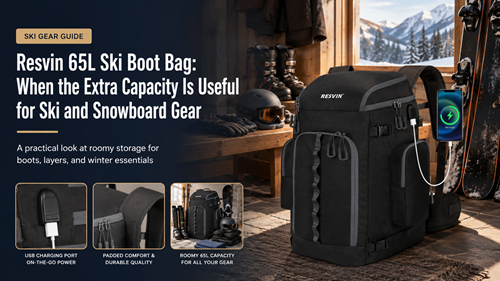
The Resvin 65L Ski Boot Bag targets travelers who want more room than a basic boot-only carrier. Sixty-five liters can be useful for boots, a helmet, goggles, gloves, layers, and smaller accessories, but capacity is only valuable when compartments keep hard wet equipment separated from fragile or dry items and the loaded backpack remains comfortable to carry.
For longer ski or snowboard trips, start with the non-negotiable hard gear: both boots and the helmet. Then add accessories by priority rather than filling every liter. The final bag should close without bulging, stand or sit predictably when set down, and remain balanced enough for the airport, shuttle, stairs, and lodging transfers in your route.
Resvin 65L Ski Boot Bag Capacity Checks
Build The 65L Load Around Boots And Helmet
Liters describe volume, not the shape of your equipment. Put the boots and helmet in first because they are the least compressible items, then see how much usable space remains without pushing hard shells into the zipper or back panel.
Start with the exact product when assessing Resvin 65L gear capacity.
Treat 1680D As A Material Claim, Not A Durability Guarantee
Heavier-denier fabric can be attractive for abrasion-prone travel, but construction quality also depends on stitching, backing, zipper design, reinforcements, and how the material is used. Inspect the entire bag rather than one number.
Use the fabric comparison when reviewing a large 1680D ski backpack.
Give Snowboard Accessories Their Own Zones
Goggles and lenses should not share unprotected space with boot buckles, tools, or other hard parts. Keep small items in dedicated pockets when available and use dry soft layers to stop movement inside larger compartments.
Use the organization guide when planning a Resvin snowboard accessory pack.
Check Whether The Extra Volume Becomes Extra Weight
A large bag encourages travelers to add “just one more” layer until the backpack is unnecessarily heavy. Pack the real trip list, weigh it, and remove low-priority items before deciding that the bag needs to be completely full.
Use the capacity calculator when testing oversized boot storage volume.
Compare 65L With Smaller And Larger Classes
The right capacity depends on trip length, clothing bulk, helmet size, and whether outerwear travels in another suitcase. A 65L bag can be a strong middle-to-large option without being automatically right for every skier.
Use the liter comparison to evaluate a 65L winter travel organizer.
Match Backpack Carry To The Full Travel Route
Backpack straps keep hands free, but 65 liters of winter gear can become tiring during long terminal walks or repeated stairs. Adjust the straps with the bag fully loaded and check whether the weight stays close to your back.
Use the carry-style comparison when planning Resvin extended-trip luggage.
65L Packing Priority Table
Use volume in order of importance. The bag is more useful when each zone has a purpose than when every empty space is filled simply because 65 liters are available.
| Priority | Gear | Packing Goal |
|---|---|---|
| 1 | Ski or snowboard boots | Stable dedicated compartment |
| 2 | Helmet | No crushing or buckle pressure |
| 3 | Goggles and lenses | Protected from hard gear |
| 4 | Gloves and base layers | Dry accessible storage |
| 5 | Small accessories | Contained in pockets or pouches |
| 6 | Optional outerwear | Add only if balance and weight stay practical |
Long-Trip Boot Bag Checklist
- Pack boots and helmet before soft items
- Keep wet soles away from dry clothing
- Protect goggles from buckles and tools
- Use compartments instead of one loose cavity
- Check every zipper with the bag standing naturally
- Adjust shoulder and chest straps under full load
- Weigh the backpack before airport travel
- Open and dry every damp compartment after use
Do a ten-minute loaded carry before the trip. If the pack pulls backward, swings, or creates pressure at the shoulders, reorganize the heavy equipment closer to the body and remove non-essential weight rather than relying on the stated 65L capacity.
Airline Rule Check
Boot bags may be treated differently depending on the airline’s sports-equipment rules and what is packed inside them. Weigh the fully loaded Resvin bag and verify whether the operating carrier counts it with skis or a snowboard, limits its contents, or applies normal checked-bag rules when extra clothing is included.
For a current official example, review American Airlines’ sports-equipment rules. Recheck the operating carrier before every trip because route, fare, weight, and baggage policies can change.
Final Buying Decision
The Resvin 65L Ski Boot Bag is most useful for longer winter trips when boots and a helmet are only the start of the packing list. Its extra volume should improve organization, not simply increase weight. The best setup keeps wet hard gear separated from fragile and dry items while remaining balanced enough to carry.
If your normal trip needs only boots, goggles, and gloves, a smaller bag may be easier to handle. If you routinely carry a helmet, layers, accessories, and travel-day essentials together, the 65L class can justify its size after a real loaded-carry test.
Frequently Asked Questions
Is 65L too large for a ski boot bag?
It depends on the trip. It can be useful for boots, helmet, layers, and accessories, but it may be unnecessarily bulky for a short boot-only carry.
Does 1680D nylon make the bag waterproof?
No. Fabric-denier and water-resistance claims do not automatically make seams, zippers, or the entire backpack waterproof.
Can a 65L boot bag replace a suitcase?
It may carry many winter items, but airline rules, weight, organization, and the need for clean clothing can make a separate suitcase more practical.
Where should goggles be packed?
Keep goggles in a protected compartment or case away from boot buckles, tools, and other hard items that can scratch lenses.
Should the boot bag be weighed separately from the ski or snowboard bag?
Yes. Weigh every piece, then check how your operating airline counts sports equipment and equipment bags for the exact itinerary.
